what part of the gramm-leach-bliley act prohibits fraudulent access to financial information
What is the Gramm-Leach-Bliley Act?
The Gramm-Leach-Bliley Act (GLB Act or GLBA), besides known as the Financial Modernization Act of 1999, is a federal law enacted in the United States to control the ways financial institutions deal with the individual data of individuals. The Act consists of three sections: The Financial Privacy Rule, which regulates the drove and disclosure of private financial data; the Safeguards Dominion, which stipulates that financial institutions must implement security programs to protect such information; and the Pretexting provisions, which prohibit the practice of pretexting or accessing individual data using false pretenses. The Act also requires financial institutions to give customers written privacy policy notices that explicate their information-sharing practices.
The GLBA repealed large portions of the Drinking glass-Steagall Banking Act of 1933 and the Bank Holding Visitor Act of 1956. It amended the rules to permit banks, brokerage houses and insurance firms to merge. This created a new structural framework whereby a bank holding company could acquire total-service investment banks and insurance companies, while allowing the latter types of firms to form property companies to larn banks. As a consequence of GLBA, the U.Southward. Federal Reserve was granted expanded supervisory power to regulate these new types of financial structures.
What is the purpose of GLBA?
The standards established by GLBA complement information security requirements imposed by the Federal Deposit Insurance Corporation (FDIC). The purpose of the GLB Act is to ensure that financial institutions and their affiliates safeguard the confidentiality of personally identifiable information (PII) gathered from customer records in paper, electronic or other forms. The police requires affected companies to comply with strict guidelines that govern information security.
Co-ordinate to the law, financial institutions have an obligation to respect their customers' privacy and securely protect their sensitive personal information against unauthorized access.
GLBA compliance requires that companies develop privacy practices and policies that detail how they collect, sell, share and otherwise reuse consumer information. Consumers also must exist given the pick to determine which data, if any, a company is permitted to disclose or retain for time to come use.
A related requirement governs information storage and security equally part of a comprehensive written information security policy. This objective addresses protections against "whatever anticipated threats or hazards" to data that could result in "substantial damage or inconvenience" to consumers.
GLBA'south PII guidelines apply to any non-public personal information, which is defined as information a client may provide to facilitate a transaction or which is otherwise obtained by the establishment.
Data covered by GLBA
GLBA compliance is intended to decrease the likelihood an organization will have a data alienation and face up the resulting fallout, including pregnant financial and legal penalties and impairment to its reputation. GLBA has become a height priority for chief information security officers and other IT professionals charged with managing corporate data.
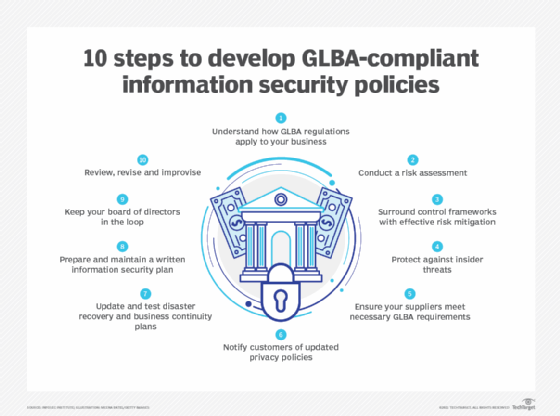
Best practices have emerged, including internal risk assessments, periodic testing of internal controls and ensuring third-party compliance by business organisation partners and service providers. Practical advantages of the law's requirements include an increased ability to place critical data, eliminate data errors, locate night data, improve consolidation and heighten information classification.
Data that falls under the requirements of GLBA includes the following:
- addresses;
- depository financial institution account and financial information;
- biometric and related data;
- nascence dates;
- car dealers;
- credit history (including property records or purchasing history);
- education level and bookish performance;
- employment information;
- inferences drawn from other data;
- internet and other electronic information;
- geolocation data;
- names;
- personal income;
- Social Security data; and
- revenue enhancement information.
Organizations regulated past GLBA
The passage of GLBA coincided with the emergence of cyberspace technologies for transacting business, which in turn generated reams of new information and new ways of accessing data. The law broadened the definition of companies classified every bit financial institutions.
GLBA regulates any establishment significantly engaged in financial activities. Even organizations that do not disembalm not-public personal information are required past GLBA to develop a policy to protect information confronting potential future threats.
In improver to banks, brokerage firms and insurers, GLBA applies to companies that process loans or otherwise assume credit take a chance. Any organization that falls within the scope of GLBA must comply with its provisions, although individual states have the ability to enact more stringent privacy regulations, as is the case in California and Virginia.
Professions and businesses discipline to GLBA'due south provisions include:
- accountants
- ATM operators
- auto rental companies
- courier services
- credit reporting companies
- credit unions
- debt collectors
- financial informational firms
- hedge funds
- non-banking company mortgage lenders
- payday lenders
- belongings appraisers
- real estate firms
- retailers
- stockbrokers
- tax preparers
- universities
How GLBA compliance works
GLBA is broken into three main sections, each of which defines a subset of rules that govern compliance. The iii sections include the following:
Financial Privacy Dominion
This dominion, often referred to as the Privacy Rule, places requirements on how organizations may collect and disclose private financial information. An organization must requite "clear and conspicuous notice" of its privacy policy at the start of a customer relationship. Subsequently, customers must get an almanac notice for the elapsing of the human relationship, unless the organization meets certain criteria.
The Privacy Dominion outlines which data will be collected, how it will exist used and shared, who has admission to it and the policies and procedures used to protect it. As required past the Fair Credit Reporting Human action, customers are to be notified of the privacy policy annually, including the right to opt out of sharing information with unaffiliated third-party entities. If a customer agrees to share data, the arrangement must abide by the provisions of the original privacy discover.
Safeguard Dominion
Every bit the name implies, steps to ensure information security are the cardinal focus of GLBA'southward Safeguard Rule. The Federal Trade Committee (FTC) issued this rule in 2002 and continues to enforce information technology. The rule instructs organizations to implement administrative, physical and technical protections as safeguards confronting cyber attacks, electronic mail spoofing, phishing schemes and similar cybersecurity risks.
The rule also requires an organization designate at to the lowest degree one person to be answerable for all aspects of the information security plan, including development and regular testing. Data encryption and key management are recommended as best practices, simply they are not FTC requirements under the Safeguard Rule.
Pretexting Rule
This rule aims to foreclose employees or business partners from collecting customer information nether fake pretenses, such as social engineering science techniques. Although GLBA does non take specific requirements regarding pretexting, prevention unremarkably entails edifice employee training to avert pretexting scenarios into the written data security document.
Who enforces GLBA requirements?
State and federal cyberbanking agencies have varying degrees of dominance to enforce GLBA provisions. The FTC can take action in federal district courts against organizations that fail to comply with the Privacy Dominion. Section five of GLBA grants the FTC the authority to inspect privacy policies to ensure they are developed and applied fairly.
Enforcement of the Safeguard Rule remains with the FTC, although the Dodd-Frank Human activity in 2010 transferred new rulemaking authority to the Consumer Fiscal Protection Bureau (CFPB). Other federal agencies that play a role in GLBA enforcement include the Federal Reserve Board, the FDIC, the Office of Thrift Supervision and the Office of the Comptroller of the Currency. The responsibility for regulating insurance providers falls to individual states.
To avoid making compliance mistakes, a visitor may choose to hire independent consulting firms. These companies conduct a GLBA audit to assess an arrangement'due south information security posture and develop strategies to stay beside of changing legal regulations.
Penalties for GLBA noncompliance
Failure to comply with GLBA tin can take severe fiscal and personal consequences for executives and employees. A financial institution faces a fine upwardly to $100,000 for each violation. Its officers and directors can be fined upwardly to $10,000, imprisoned for 5 years or both. Companies besides face increased exposure and a loss of customer confidence.
Heightened awareness of security risks is among the benefits companies may derive from GLBA compliance, particularly as hackers develop more sophisticated tools to breach computer systems. Aside from enhanced brand reputation, a company tin can gain new insights from existing data and improve its data management capabilities.
Contempo GLBA cases brought by the FTC include:
- Ascension Information and Analytics. In 2020, the Arlington, Texas, company agreed to an undisclosed financial settlement after a vendor, OpticsML, was found to have stored customer financial information in patently text in insecure cloud storage.
- PayPal. The online payment processor agreed to pay $175,000 to the state of Texas in 2018 to settle GLBA and Federal Trade Act violations that compromised data security and privacy of customers using its Venmo peer-to-peer application.
- TaxSlayer. Hackers were able to access nearly 9,000 of the Augusta, Ga., online tax preparer's customer records for several months in 2015. The FTC said it failed to implement a comprehensive security plan, including providing a privacy notice to customers, as required nether GLBA. Under the settlement with the FTC, the visitor is prohibited from violating the GLBA'south Privacy Dominion and the Safeguards Dominion for 20 years and is required to have a third political party appraise its compliance every 2 years for 10 years.
Criticism, problems and GLBA revisions
Critics of the GLBA take contended the measure's enforcement lacks the regulatory capabilities of the Health Insurance Portability and Accountability Act (HIPAA) and privacy regulations similar those enacted in California. The GLBA places the responsibleness on individuals to notify companies when they are opting out of data collection. The limited opt-out rights facilitate greater data sharing among larger entities, which is the opposite of what was intended, critics said.
Some economists blamed the GLBA for contributing to the 2008 financial recession. They argued the repeal of the Glass-Steagall Act opened the doors for banks to appoint in speculative investments using short-term hedge funds and other loftier-yield, loftier-gamble fiscal instruments.
Other financial experts claimed the GLBA played only a marginal part in the economical crisis. They pointed to a overabundance of Fannie Mae- and Freddie Mac-owned subprime mortgages that Congress directed be bought to supply affordable housing in low-income neighborhoods.
The CFPB revised the GLBA in 2018 to exempt some companies from the requirement to evangelize annual privacy notices to customers nether certain conditions. In full general, financial institutions are exempted in two ways: if they restrict data sharing and don't trigger a customer opt-out requirement or if at that place are no changes to the privacy policy previously delivered to the client. The CFPB said the revision conforms with GLBA amendments established by Congress.
GLBA and GDPR
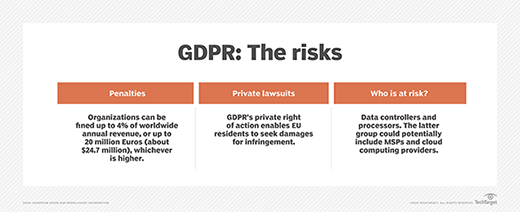
GLBA and Europe's Full general Data Protection Regulation (GDPR) have different goals, but both define information security and consumer privacy. Whereas GLBA sets data privacy rules for financial institutions, GDPR encompasses any organization that processes an private'due south personal data in the grade of transacting business.
Similar GLBA, GDPR encourages companies to be more transparent in how they capture and handle sensitive information. That includes individuals' personal data and any metadata that may be used to identify or characterize them.
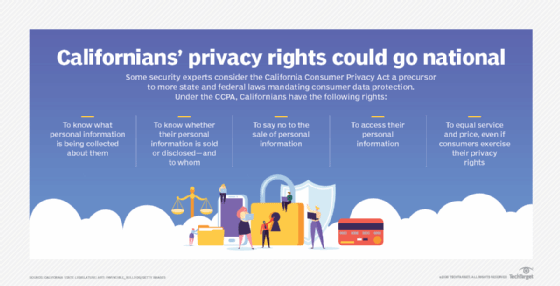
In 2021, the Commonwealth of Virginia General Assembly passed the Virginia Data Protection Human activity, becoming the 2nd U.S. state to enact regulations that toughen consumer protections. Virginia's constabulary mirrors many provisions in the California Privacy Rights Act (CPRA). CPRA is an expanded version of the California Consumer Privacy Act, which guarantees individuals the correct to know all personal information a company may collect. CPRA gives Californians and others broad authority to obtain, delete and restrict the employ of any personal data. Any organisation that transacts business in California may be subject to CPRA provisions.
Illinois, New York, Oregon, Texas and Washington are updating existing security laws, and the National Clan of Insurance Commissioners has developed a model police force to enable states to develop laws that uniformly protect personal data.
History of GLBA
The Gramm-Leach-Bliley Human action is named for the lawmakers who sponsored it: Sen. Phil Gramm (R-Texas), Rep. Jim Leach (R-Iowa) and Rep. Thomas Bliley (R-Va.). The U.S. Senate passed GLBA by a 54-44 margin in May 1999. The U.Southward. House of Representatives approved a version of the act in July 1999 with a 343-86 vote. A revised version of the bill passed both houses -- past votes of 90-8 in the Senate and 362-57 in the Business firm -- on Nov. iv, 1999; President Bill Clinton signed GLBA into law on November 12.
GLBA emerged during a wave of government business regulation in the belatedly 1990s. Congress passed HIPAA in 1996 and the Sarbanes-Oxley Public Company Accounting Reform and Investor Protection Deed in 2002.
Federal regulators had relaxed some Glass-Steagall prohibitions in the years leading upwardly to the GLBA. These steps helped pave the way for commercial banks and securities investment firms to merge and sell integrated fiscal services. However, this development renewed data privacy concerns that had been simmering for several years.
The EU Data Protection Directive, a 1995 European law that imposed stricter requirements on U.S. firms, was emblematic of this concern. Any U.S. company providing products or services to European union citizens must afford them the same privacy protections as those imposed by information exchanges in their abode countries. The European Union in 2016 approved the GDPR to supersede the Data Directive police force; the GDPR became constructive in 2018.
In 1999, the year GLBA became constabulary, U.Due south. Bancorp, based in Minneapolis, Minn., was sued by the state of Minnesota for peddling confidential customer information to a telemarketing firm that allegedly debited their accounts without permission. In 1999, Charter Pacific Depository financial institution, in Agoura Hills, Calif., was involved in a porn scam after selling access to a database of credit carte accounts to a California-based business organization functioning. According to the FTC, the visitor used fictitious names and fake merchant accounts to beak unsuspecting customers in excess of $40 million for admission to porn websites. The FTC won a $37.5 million judgment against the owners of the business. Selling access to the credit card database was not illegal, and then the banking concern escaped fiscal penalisation.
Discover out more virtually how the scramble to comply with a slew of new consumer information privacy laws and regulations is affecting Information technology and security processes.
Source: https://www.techtarget.com/searchcio/definition/Gramm-Leach-Bliley-Act
0 Response to "what part of the gramm-leach-bliley act prohibits fraudulent access to financial information"
Post a Comment